A local search tool for a living singing tradition—and the collection behind it.
Obsidian notesSearch indexLocal tool
The tradition
What is Sacred Harp?
Sacred Harp is a group singing tradition from the United States. Singers use The Sacred Harp, a book of hymns and other songs. They sit in a square and sing together.
No audience
The singers make the music.
Many editions
The same text can appear in different books.
Shared leadership
Singers take turns leading songs.
Speaker noteBasis: the earlier local Sacred Harp presentation, “Sacred Harp from the ground up.”
How singing works
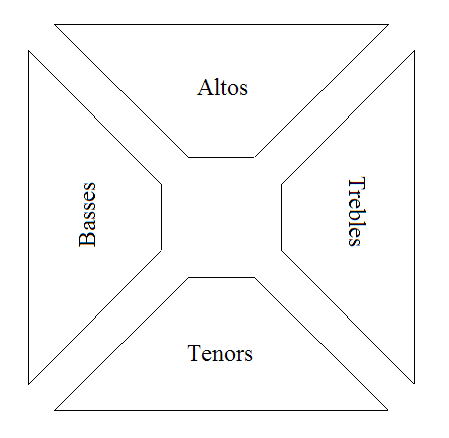
The hollow square
Four sectionsTreble · Alto · Tenors · Basses
→
Everyone faces inward. The leader stands in the middle and beats time. The geometry makes listening mutual: the sound is aimed at the square, not at a stage.
How notation works
Four shapes help people learn the notes.
Each shape names a syllable: fa · sol · la · mi. Singers use the shapes to learn unfamiliar music.
Fa
Sol
La
Mi
The shapes are a navigation system, not decoration: they help a singer enter unfamiliar music together with the room.
A page from the repertoire
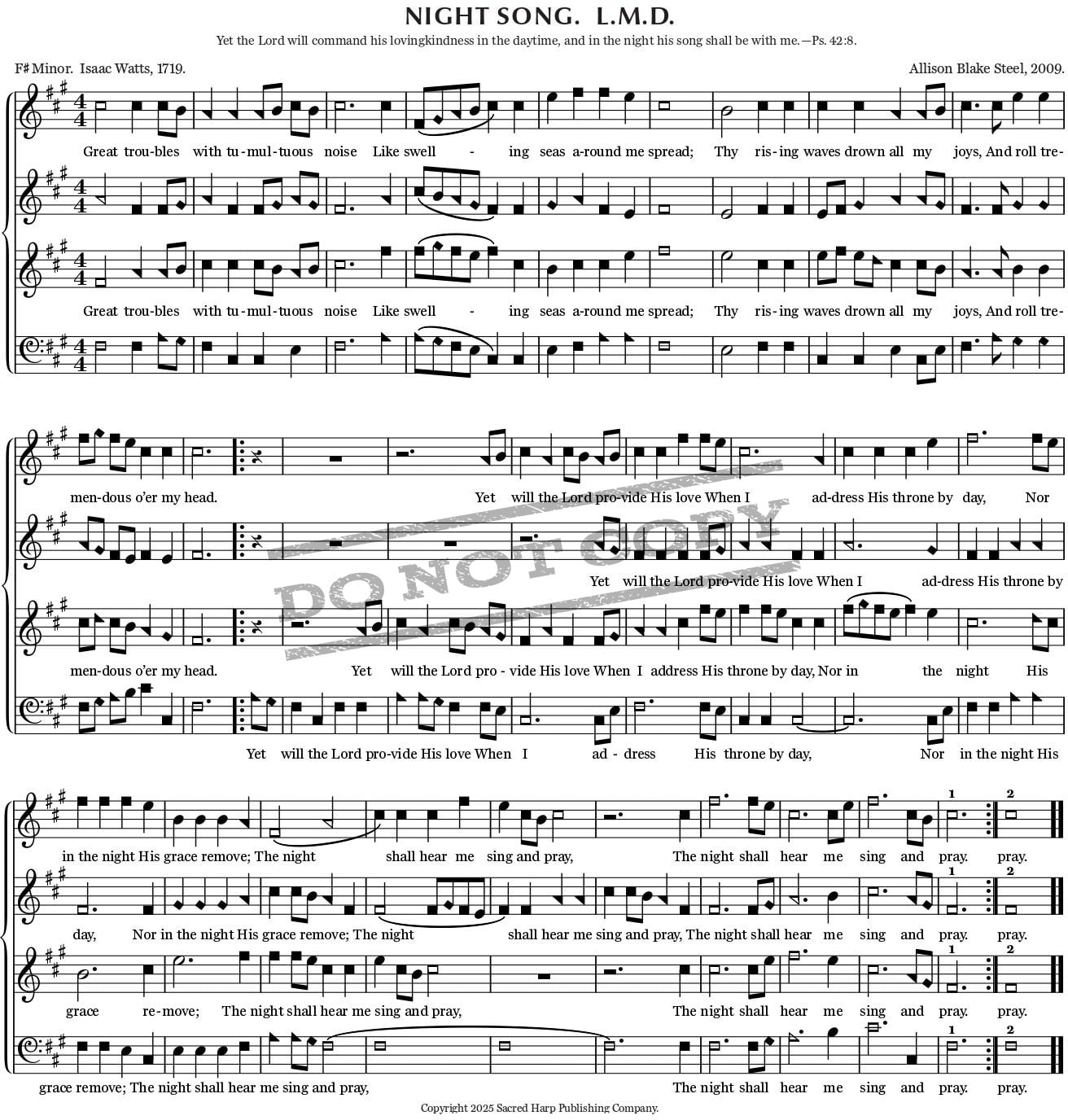
264 · Night Song
A sheet-music page shows the title, meter, key, four parts, and text that the tool can search.
Someone gives the starting notes so the room can enter.
3Sing the notes
The group often sings the melody on fa-sol-la-mi first.
4Sing the words
Then the poetry arrives with the full force of the parts.
“The singers are the music.”Framing carried forward from the earlier Sacred Harp explainer
The problem
A rich tradition is hard to search.
The same text, many places
A lyric can recur under different tune names, page numbers, books, and editions.
The same tune, new context
Revisions preserve continuity while changing metadata, arrangement, or text presentation.
A flat search loses the why
A result is not enough. The researcher needs source notes, book families, and a traceable explanation.
The corpus is alive
Local notes, scans, transcriptions, and research discoveries accumulate over time.
What I built
A local tool for searching the collection.
I built the tool because the same text can appear under different songs, books, and editions. It searches those records and shows where each result came from.
01
Keep source links
Source note
Book and edition
Song and text
02
Search the notes
SQLite / FTS5
Text and song records
Cross-book links
03
Show the source
Matching text
Citations
Known limits
Live demo · have the environment running
Trace one question from text to evidence.
Ask: “Where else does this text appear?” A good answer is a small map, not a single hit.
Match
“Night Song”
Find the text family and its known song records.
Trace
Source text
Connect the 2009 setting to Isaac Watts, 1719, and Psalm 42.
Interpret
Context
Separate the older text from the newer musical setting.
“Great troubles with tumultuous noise”264 “Night Song”: the lyric to trace across editions and related books.
Course concepts
Four ideas shaped the project.
Question“Where does this text appear?”
→
AnswerResults with links back to the source.
Search
Find matching records.
Data structure
Connect songs, texts, and books.
RAG
Give the model search results before it answers.
Testing
Measure correct results.
By the numbers
The collection and the results.
5,300+interconnected notes
3,326song notes
1,972canonical text notes
10tunebook traditions
Evaluation snapshot
92.4%correct match in the top 5 results
99.6%lyrics match in the top 5 results
38.9%answers improved by search
5,022examples tested
The tool found text well. It was less reliable when it had to write missing metadata: 17.4% correct.
Retrospective
What worked and what did not.
Went right
Evidence stayed attached to the answer.
Harder than expected
Corpus cleanup and edition matching.
Went horribly wrong
A plausible answer can still blend sources.
Do differently
Design the evaluation set before polishing the interface.
Harder than expected
Corpus cleanup was the hidden project.
Identity drift
The same text can have different names, numbers, and book appearances.
Incomplete metadata
Some notes had rich prose but no reliable meter, key, or lyricist field.
Evaluation design
It is easy to show that search returns something; it is harder to prove that it returned the right relationship.
Takeaway
Retrieval quality depends on the data model long before the chat interface.
What went horribly wrong
A plausible answer can still be wrong.
A model can sound confident while blending editions, guessing missing metadata, or citing a nearby match.That failure mode is exactly why this project keeps source identity and uncertainty visible.
The failure
Semantic similarity alone can collapse distinct songs or text families into one fuzzy result.
The repair
Route by type, preserve keys, surface matched fields, and make the human-readable source part of the answer.
If I did it again
Design the evaluation set before expanding the interface.
01
Define cross-book test pairs first.
02
Record expected provenance with every benchmark question.
03
Build the citation view before adding more conversational polish.
The next version should make correctness visible at a glance.
A page from the repertoire
264 · Night Song
A sheet-music page makes the corpus tangible: title, meter, key, four parts, text, and the possibility of hearing each section separately.